August 11, 2026
Corner Cabinets: Smart Solutions for Hard-to-Reach Spaces
Corner kitchen spaces are often difficult to access and easy to waste. Discover the best corner cabinet solutions, from lazy Susans and pull-out systems to custom drawers and shelving, and learn how thoughtful cabinet design can turn awkward corners into practical, organized storage.
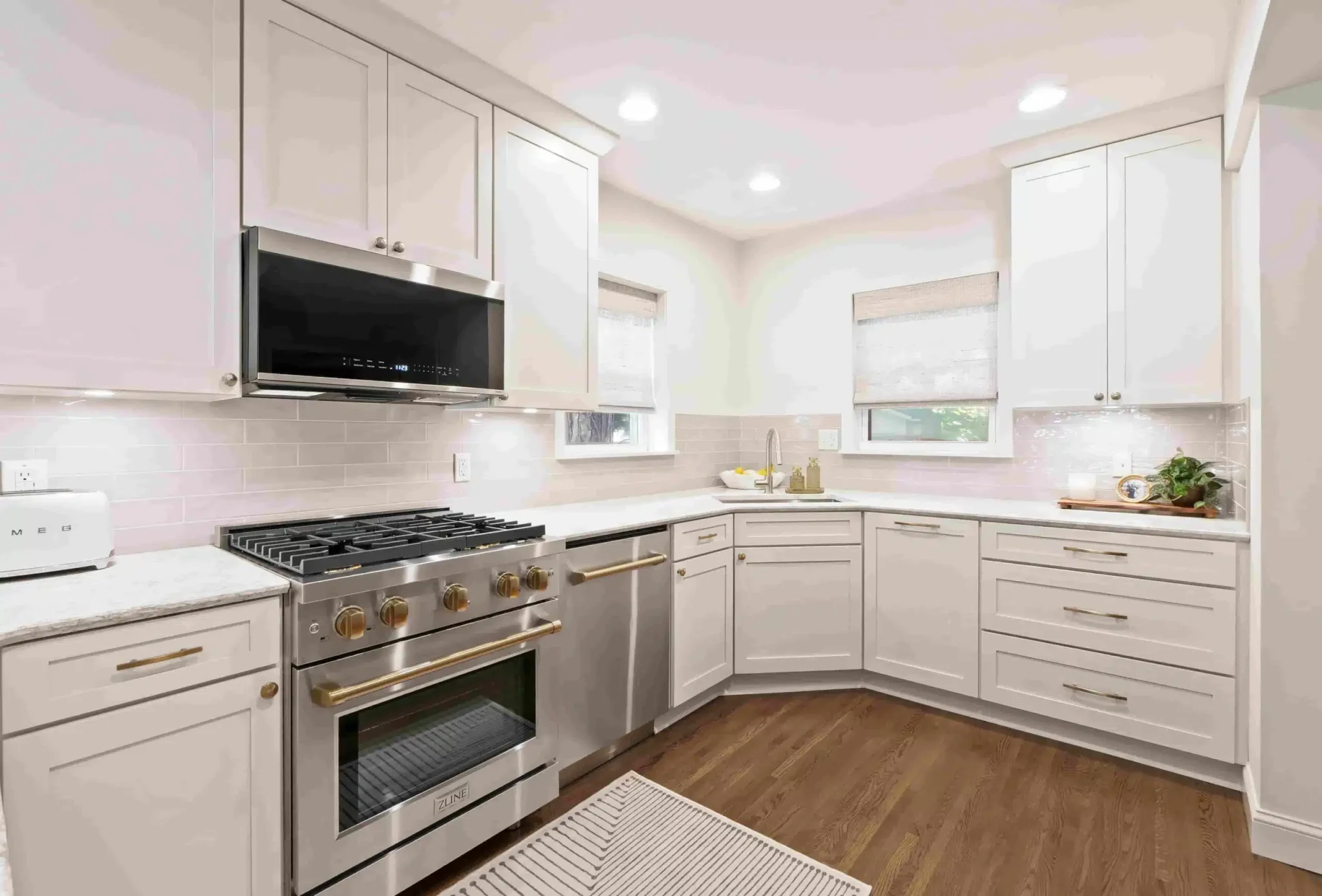
Corner Cabinets create an interesting design challenge. On paper, they appear to offer a generous amount of cabinet space, but in everyday use, that space can quickly become one of the least convenient areas of the kitchen. Deep corners are difficult to see into, items are pushed behind one another, and cookware stored at the back may stay there simply because retrieving it requires too much effort.
This is why corner cabinets require more planning than standard base cabinets. A well-designed corner should not simply provide additional cubic feet of storage. It should make that storage accessible, organized, and useful for the way the kitchen functions every day.
Fortunately, modern cabinetry has moved far beyond the traditional deep corner cabinet with a fixed shelf. Lazy Susans, blind-corner pull-outs, swing-out organizers, corner drawers, and custom shelving systems can transform awkward spaces into practical storage zones.
The right solution depends on the kitchen layout, cabinet dimensions, what you plan to store, and how frequently you need to access those items. When these factors are considered during the design process, corner cabinets can become some of the most productive storage areas in the kitchen rather than places where cookware disappears.
Why Corner Cabinets Are Difficult to Use
Most kitchen cabinetry is relatively straightforward because the door or drawer sits directly in front of the storage area. Corner cabinets are different. Two runs of cabinetry meet at a 90-degree angle, creating storage space that extends significantly farther than the visible cabinet opening.
In a conventional corner cabinet, accessing that depth often requires reaching around the cabinet frame or moving several objects before reaching something stored toward the back. Large pots, small appliances, serving pieces, and pantry products can gradually accumulate in these areas because homeowners know the storage exists but cannot use it efficiently.
The problem becomes especially noticeable in busy kitchens. If retrieving a skillet requires crouching down, moving three other pans, and reaching into a dark corner, that cabinet will naturally become less useful over time.
Accessibility is important enough that the National Kitchen & Bath Association recommends that when corner cabinetry is included in a kitchen, a functional storage device should be incorporated to improve access to the interior. NKBA Kitchen & Bath Planning Guidelines
Well-designed corner cabinets storage should solve several problems at once:
- Make stored items visible
- Bring items closer to the cabinet opening
- Reduce excessive reaching and bending
- Use as much of the available cabinet volume as possible
- Keep frequently used items organized
- Prevent cookware and supplies from becoming buried at the back
The goal is not necessarily to fill every possible inch. A storage system that uses slightly less physical space but makes everything easy to reach can be considerably more valuable than a larger cabinet that is frustrating to use.
Lazy Susans: A Classic Corner Cabinet Solution
The Lazy Susan remains one of the most recognizable solutions for kitchen corner cabinets, and there is a good reason it has remained popular for so long. Instead of forcing homeowners to reach into the deepest part of the cabinet, rotating shelves bring items toward the front.
Traditional systems typically use one or more circular, kidney-shaped, or pie-cut shelves mounted around a central post. The homeowner rotates the shelf until the desired item reaches the cabinet opening.
This relatively simple mechanism can dramatically improve the usability of a corner cabinet.
Lazy Susans work particularly well for storing:
- Pots and pans
- Mixing bowls
- Food storage containers
- Small appliances
- Dry pantry ingredients
- Baking supplies
- Everyday cookware
They can also be useful when several medium-sized objects need to share the same corner because the rotating platform eliminates the need to move everything sitting in front of them.
Choosing the Right Lazy Susan Configuration
Not every Lazy Susan works in the same way. Full-circle models are often used where cabinet construction allows the entire rotating shelf to operate freely, while kidney-shaped and pie-cut designs are commonly installed in traditional corner base cabinets.
Half-moon organizers provide another option, particularly for blind corners. Some systems rotate toward the cabinet opening and then extend outward, making it possible to access items that would otherwise remain hidden deep inside the cabinet.
Modern organizers are available in wood, polymer, metal, and combinations of these materials. Manufacturers such as Rev-A-Shelf offer rotating and pivoting corner systems designed specifically to improve access within base and blind-corner cabinets. Explore Lazy Susan and corner storage systems from Rev-A-Shelf
When selecting a system, homeowners should consider shelf capacity as carefully as shelf shape. Heavy cast-iron cookware, countertop appliances, and stacks of dishes place very different demands on hardware than lightweight pantry products.
A properly sized, high-quality rotating system should move smoothly even when loaded and provide enough clearance that items do not interfere with cabinet doors or adjacent storage.
Blind Corner Cabinets and Pull-Out Systems
A blind corner cabinet is created when one cabinet extends into the corner while part of its storage area sits behind the cabinet beside it. Only one section is directly accessible through the door, while the remaining portion extends into what is essentially a hidden side cavity.
These cabinets can provide substantial storage volume, but without specialized hardware they are also among the hardest cabinets to use.
Older blind corners are often filled with cookware that homeowners rarely need because reaching the back requires considerable bending and stretching. Modern pull-out systems solve this problem by physically moving the contents of the cabinet toward the user.
How Blind Corner Pull-Outs Work
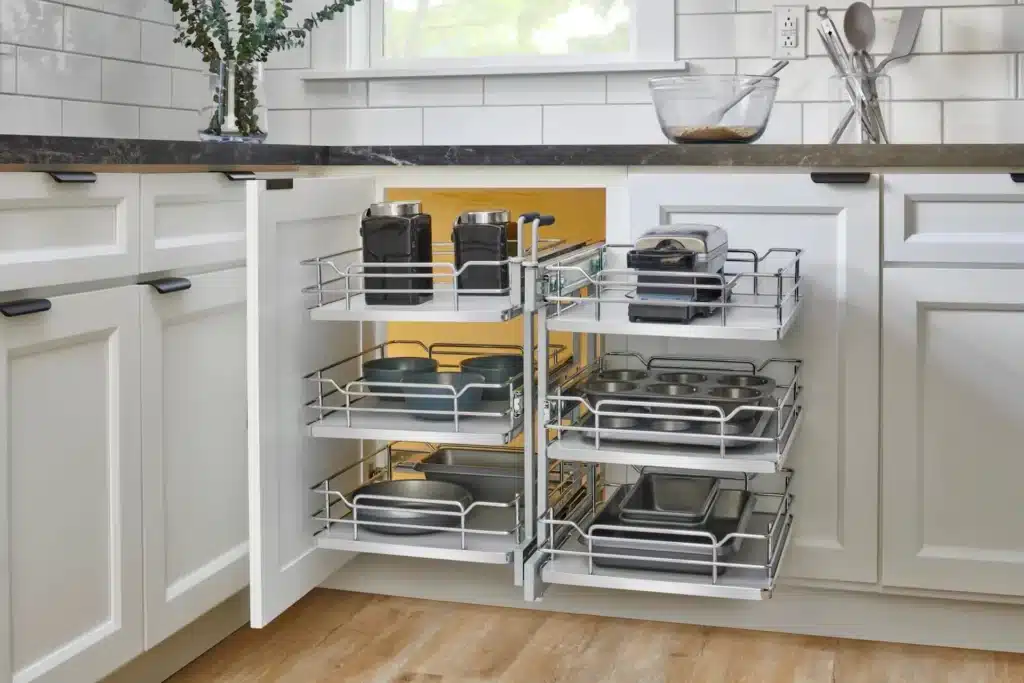
Different hardware manufacturers use different mechanisms, but the basic principle is similar. Shelves or baskets stored inside the corner move forward, pivot sideways, or slide entirely outside the cabinet when the user opens the system.
Some designs use two sets of shelves. The front section pulls outward first, allowing the rear shelves to slide sideways into the cabinet opening. More advanced organizers synchronize these movements so the entire system can be accessed with relatively little effort.
Other designs use independent baskets that pivot and extend individually.
The advantage is significant: instead of reaching into the cabinet to find stored items, the storage system brings those items into view.
These systems are particularly useful for:
- Heavy pots and pans
- Dutch ovens
- Small appliances
- Serving bowls
- Baking equipment
- Food storage containers
- Less frequently used cookware
Rev-A-Shelf describes its modern blind-corner organizers as using combinations of pivoting, sliding, and pull-out movement to make the previously hidden portion of the cabinet accessible. See blind corner cabinet accessory options
For homeowners who use their kitchen frequently, this type of hardware can turn an inconvenient cabinet into a highly functional storage center.
Corner Drawers: Bringing Storage Directly to You
Corner drawers take an entirely different approach. Instead of trying to access a large cabinet cavity through hinged doors, the corner is divided into drawers that extend diagonally into the available space.
When closed, the cabinetry still follows the 90-degree kitchen corner. When a drawer is opened, however, the entire storage compartment comes toward the user.
This provides one of the biggest advantages of drawer-based kitchen storage: immediate visibility.
With traditional shelving, items are often stacked behind or underneath one another. A full-extension drawer allows homeowners to look directly down into the storage area and identify what they need.
Corner drawers can be particularly effective for:
- Cooking utensils
- Pots and pans
- Food storage containers
- Baking tools
- Small kitchen accessories
- Dishware
- Kitchen linens
They can also create a very clean architectural appearance because the drawer fronts integrate naturally with surrounding cabinetry.
There are trade-offs. Because drawer boxes require structural framing and hardware, they may not use every cubic inch of the underlying corner. They can also require more sophisticated cabinet construction than a conventional corner cabinet.
However, maximizing storage is not purely a question of volume. A slightly smaller storage area that is easy to open, organize, and access can be considerably more useful than a deep cabinet containing more theoretical space.
For homeowners who prefer drawers throughout their lower cabinetry, corner drawers can also preserve consistency rather than interrupting a run of drawers with a large corner door.
Swing-Out and Pivoting Corner Organizers
Swing-out organizers offer another solution for homeowners who want the accessibility of drawers but need to work within a traditional cabinet configuration.
These systems typically feature shelves or baskets attached to articulated hardware. Opening or pulling the organizer causes the shelves to move through the cabinet opening, allowing items from deep inside the corner to travel toward the user.
The movement itself is what makes these systems effective. Instead of treating the corner as a stationary storage box, the interior components become mobile.
When Swing-Out Storage Makes Sense
Swing-out systems are particularly useful when homeowners want to store larger pieces of cookware that do not fit comfortably on smaller rotating shelves.
For example, a corner organizer might hold:
- Stockpots
- Large skillets
- Mixing bowls
- Small countertop appliances
- Casserole dishes
- Serving pieces
- Baking pans
Because shelves move independently on some models, organization can also be divided by purpose. One section might hold frequently used cookware while another stores appliances or occasional serving pieces.
Quality hardware becomes especially important with these systems. Moving shelves carrying heavy cookware place considerable demands on slides, hinges, and mounting hardware. The cabinet itself must also be designed with the correct opening dimensions and clearances.
This is one area where planning the organizer at the same time as the cabinetry is preferable to trying to fit hardware into an existing cabinet afterward.
How to Choose the Best Corner Cabinet Solution
There is no universal corner cabinet system that works best in every kitchen. The right choice depends on how the corner fits into the surrounding layout and what homeowners actually intend to store there.
A household that cooks every evening may prioritize fast access to heavy cookware. Someone with a large pantry may use the corner primarily for occasional appliances or serving pieces. A smaller kitchen may need the corner to perform multiple storage functions at once.
Several factors should guide the decision.
Consider What You Will Store
Start with the contents rather than the cabinet mechanism.
If the space will hold lightweight pantry products, a rotating Lazy Susan may provide all the accessibility you need. If it will contain heavy cookware, a strong pull-out system or deep corner drawers may provide better support and easier handling.
Small appliances introduce another consideration. Blenders, pressure cookers, mixers, and food processors require enough vertical clearance and shelf depth, while also benefiting from a system that eliminates the need to lift them from the back of a cabinet.
The best storage design begins with an inventory of what needs to live in that part of the kitchen
Think About Frequency of Use
Prime storage locations should generally be reserved for items that are used regularly.
If the corner cabinet sits beside the cooktop, it may make sense to use it for pots, pans, lids, and cooking equipment. A corner located farther from the primary preparation zone might be better for serving dishes or appliances used occasionally.
Kitchen storage works most efficiently when items are positioned close to the activities associated with them.
The NKBA’s planning guidance emphasizes organizing kitchens around functional activity zones and accessible storage rather than treating every cabinet as an isolated container. Learn more about NKBA kitchen planning guidelines
Thinking about the kitchen in this way can help determine whether a particular corner needs extremely convenient daily access or simply organized secondary storage.
Measure the Cabinet Opening Carefully
The amount of space inside a corner cabinet is only part of the equation. The width and height of the actual door opening determine which organizers can move into and out of the cabinet.
Hinges, face frames, doors, adjacent drawers, appliances, and cabinet construction can all affect clearance.
This is particularly important with pull-out and pivoting organizers. A mechanism may physically fit inside the cabinet while still being unable to move correctly through the opening.
Accurate measurements should include:
- Cabinet width
- Cabinet depth
- Cabinet height
- Door opening width
- Interior obstructions
- Hinge placement
- Adjacent cabinet and appliance clearances
When cabinetry is being custom-designed, these dimensions can be coordinated with the selected organizer from the beginning rather than forcing the storage hardware to adapt to an unsuitable cabinet afterward.
Consider Who Uses the Kitchen
Accessibility should also influence the choice.
Deep stationary shelves can be particularly inconvenient for anyone who has difficulty bending, reaching, or lifting objects from awkward positions. Pull-out shelves and drawers allow stored items to move into a more comfortable reach range.
The NKBA notes that cabinet interiors and storage accessories should be planned with different users’ reach and range of motion in mind.
This does not only apply to homeowners with specific mobility needs. Ergonomic storage can make everyday kitchen tasks easier for almost everyone and can help a kitchen remain practical as household needs change over time.
Designing the Entire Kitchen Around Better Corner Storage
Corner storage works best when it is considered as part of the complete cabinetry plan rather than treated as a problem to solve after the rest of the kitchen has been designed.
Sometimes the best corner cabinet is not a traditional corner cabinet at all.
Depending on the layout, designers may choose to eliminate the internal corner and use drawers from each perpendicular cabinet run instead. In another kitchen, a large Lazy Susan may create the most efficient configuration. A blind-corner system may preserve valuable drawer width along the neighboring cabinet run, while corner drawers may offer the best balance between appearance and accessibility.
The location of appliances matters as well. A dishwasher, oven, refrigerator, or wide drawer positioned too close to the corner can interfere with adjacent doors. Handles and knobs must also have enough clearance so two cabinet fronts do not collide.
For this reason, corner cabinetry should be evaluated together with:
- Appliance placement
- Drawer widths
- Cabinet door swings
- Countertop dimensions
- Sink and cooktop locations
- Traffic patterns
- Work zones
- Storage priorities
Thoughtful design often prevents problems that no storage accessory can completely fix afterward.
Custom cabinetry provides a particular advantage in these situations because cabinet dimensions can be adapted to the room instead of forcing the room to fit a predetermined set of cabinet sizes.
Irregular walls, unusual corners, larger appliances, and unique storage requirements can all be incorporated into the design from the beginning.
Plan. Build. Enjoy.
Request your personalized cabinet quote and see how Mastery Cabinetry transforms your space.
Get My Free QuoteMake Every Corner Work Harder
Kitchen corners do not have to become dark storage areas filled with forgotten cookware. With the right cabinetry and hardware, they can provide organized, accessible storage that supports everyday cooking and makes better use of the room.
A Lazy Susan may provide a simple and reliable solution for one kitchen, while another may benefit from sophisticated blind-corner pull-outs. Corner drawers can create exceptional visibility and easy access, while swing-out organizers allow deep spaces to accommodate larger cookware and appliances.
The most important decision is not choosing the most elaborate mechanism. It is choosing the solution that fits the cabinet, the layout, and the way the homeowner uses the kitchen.
At Mastery Cabinetry, we design custom cabinetry around the realities of everyday living. From difficult kitchen corners and deep drawers to pantry systems, appliance storage, and specialized organizers, every element can be planned to improve accessibility while maintaining a cohesive design.
When storage is considered from the beginning of the design process, even the most challenging corner can become a useful part of the kitchen rather than wasted space.
Ready to make better use of every inch of your kitchen? Request a free consultation with Mastery Cabinetry and discover how custom cabinetry and thoughtful storage solutions can transform even the hardest-to-reach spaces.
Further Reading: